
Your Cart is Empty
Free Shipping Over £40 | Standard Shipping £3.95
Free Shipping Over £40 | Standard Shipping £3.95
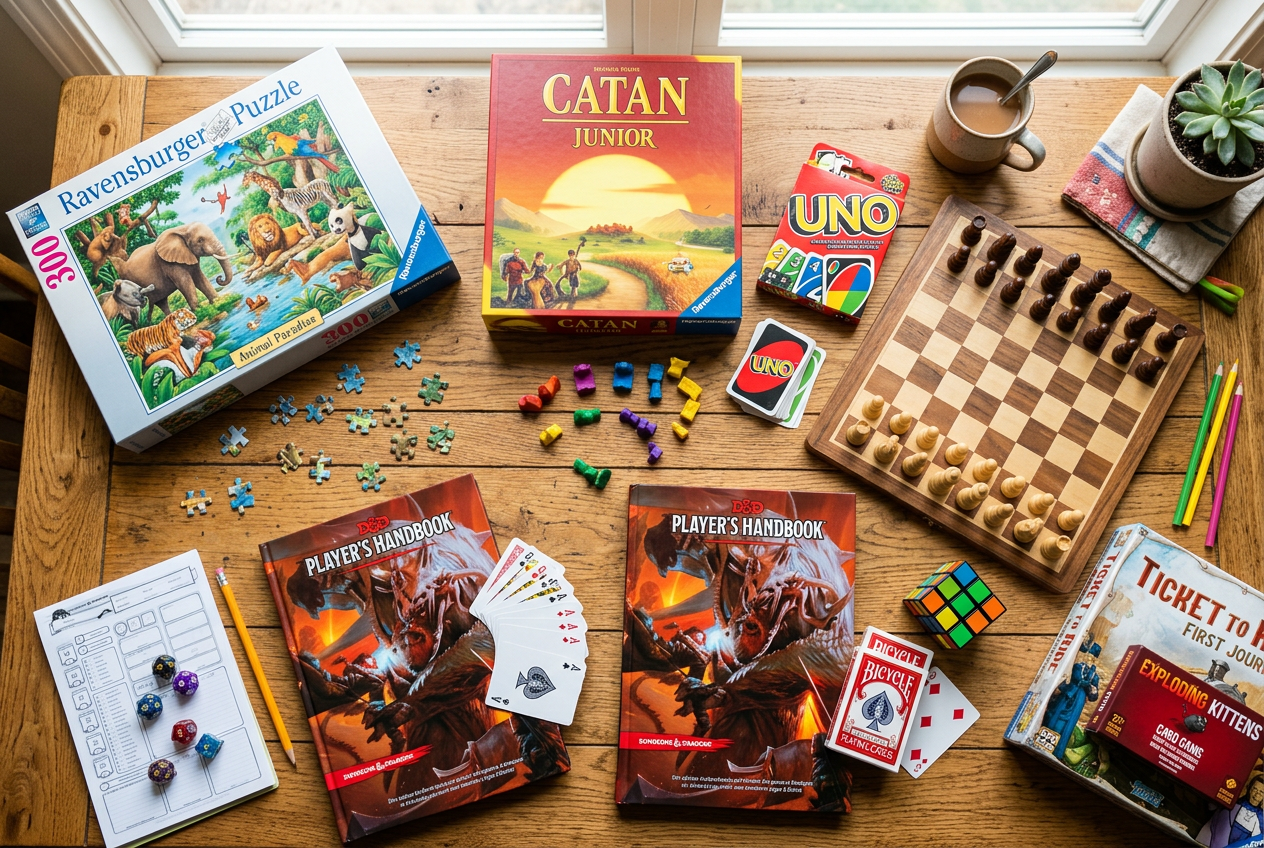

Why screen-free games and toys are good for children (and what the evidence really says)
December 01, 2024 4 min read
We sell games and toys for a living, so you might expect us to tell you that screens are the enemy. We won't, because that is not what the evidence says.
What we will say is that games and toys give children two things a screen usually does not: other people in the same room, and something to do with their hands. Here is what the paediatricians actually say, why it matters, and a few things from our shelves that make the swap easy.
Is screen time bad for children?
Not in the way the headlines suggest. The UK's Royal College of Paediatrics and Child Health (RCPCH) published a screen time guide in January 2019. It found the evidence for a direct harmful effect from screens to be contested and the size of the effect small, and it said the risks should not be overstated. Its concern is what screens push out: sleep, physical activity and time with other people.
How much screen time is OK for children?
There is no single number. The RCPCH sets no universal time limit and recommends that families agree limits with their children.
The Canadian Paediatric Society goes further for the youngest children. Its 2017 advice is that children under five need active play and family time to develop essential life skills. It recommends no screen time under the age of two, less than an hour a day from two to five, and no screens for an hour before bed. The RCPCH also advises keeping the hour before bedtime screen-free.
So the case for screen-free play is not that screens are poison. It is that a child's day is short, and play, sleep and family time are worth protecting.
Why are screen-free games and toys good for children?
- Play is how children learn. UNICEF describes free play as important for children's cognitive, physical, social and emotional development. It says play helps them explore the world, express feelings, build vocabulary and work out problems for themselves. A pile of blocks or a deck of cards is free play waiting to happen.
- Games happen between people. Both sets of guidance put face-to-face time first. A board game builds in taking turns, waiting, losing and trying again, and you do it all next to someone.
- They protect sleep. With screens off for the hour before bed, a quiet card game, a jigsaw or a bedtime story fills the gap without a bright screen.
- They are hands-on. Building, sorting, pouring and sliding use the body as well as the brain, which fits UNICEF's point that play supports physical as well as mental development.
- They finish. This one is our view, not research. A game ends when it ends, and a kit is done when it is built. There is no autoplay and no next episode, which makes it easier to stop.
Does screen-free mean screen-banned?
No. Nothing here says tablets and television have no place. The RCPCH's own advice is to talk it through as a family and agree what works, rather than to follow a single rule. The aim is a balance in which the good stuff, play, sleep and each other, gets enough room.
What are the best screen-free games and toys to start with?
Here are five from our shelves, from age 3 up.
| Pick | Age | Why it works |
|---|---|---|
| Tiny Polka Dot: Maths Games | 3 to 8 | Sixteen easy-to-learn card games that build counting, arithmetic and logic, and grow with your child |
| Outfoxed! Cooperative Deduction Board Game | 5+ | Everyone plays on the same side to catch the fox, so it practises working together and deduction |
| Ghost Blitz | 6+ | A fast observation game with wooden figures, good for mixed ages around one table |
| Prime Climb Maths Game | 10+ (8+ with an adult) | Multiplication, division and prime numbers learnt by playing, not by worksheet |
| Hydraulic Cyborg Hand Construction Kit | 10+ | Build a robotic hand that runs on water alone, with no motor or batteries |
We have lots more in our age collections, sorted by what suits your child.
How can you cut screen time without a battle?
- Put a game where the tablet usually lives. Out of sight is half of out of mind.
- Make a game the last thing before bed. Both bodies of guidance advise keeping the last hour screen-free.
- Let them choose. The RCPCH recommends agreeing limits with children, and children stick to what they helped decide.
- Play the first round with them. Rules are a chore until you have played once. After that, the game can run without you.
- Keep a small game in the bag. Cards and travel games turn waiting rooms and train journeys into play time.
Frequently asked questions
Are board games better than educational apps?
Neither guide we read ranks them. What a game adds is other people and something to handle, and apps can be good tools too.
What screen-free toys suit under-fives?
Tiny Polka Dot is designed for ages 3 to 8, and our age collections have more.